

The short version: freeze-drying candy works because trapped gas expands as the moisture around it sublimates, so the texture change is the product, not a side effect. Harvest Right puts candy among the fastest cycles it publishes, "often completing in just a few hours compared to the 13–35 hours required for most foods" [1]. Finished candy is the one category where moisture, not oxygen, is the documented failure mode, which changes what goes in the container [6][15][17].
Foods
Freeze-dried candy: what happens and what it needs.
What the vacuum actually does
Harvest Right's own mechanism statement is short: "During freeze drying, the moisture inside the candy is removed through sublimation" [1]. Water in the frozen piece passes straight from solid to vapor under vacuum, and the gas already trapped in the candy's structure expands into the space it leaves. That is why the same process that shrinks a strawberry inflates a Skittle.
Two things the process does not do are worth stating plainly, because they set the limits of everything below. It does not remove fat: "Freeze drying removes water, but oil remains" [2], which is why solid chocolate is advised against rather than merely difficult [2][9]. And it does not change the sugar into something less thirsty. The finished piece is drier than the room it sits in, and that gradient runs one direction.
What works, and what the sources actually say
Every status below is what a manufacturer or extension source publishes, not a result Sublime Pantry produced. Where two pages from the same company disagree, both are shown.
| Candy type | Published status | What sources say happens | Stated warning |
|---|---|---|---|
| Gummy | Documented as suitable [3][4] | Expansion figures conflict inside one company: "grow nearly double in size" [3] versus "puff up and quadruple in size" [4] | Spread with room to expand; silicone mat or parchment liner [3]. No freezing-first instruction is published |
| Hard candy (Jolly Ranchers, Skittles) | Contradicted. Featured as a success on the candy pages [1][3][4]; grouped with "candies with high sugar content and low water content" among foods that may not freeze dry well in the general guide [5] | Gas trapped inside expands as moisture sublimates [1]. A secondary account adds that the little water present leaves the sugar glass and the sugar recrystallizes into an opaque foam [6] | Never seal a piece with a "translucent glassy core" — that indicates incomplete drying, and trapped moisture migrates inside a sealed container [6] |
| Taffy | Documented as suitable [1][3][4] | "Expands and becomes light and crispy" [1]; "so airy that it melts in your mouth" [4] | Cut into halves or quarters; use a liner [3] |
| Marshmallow | No manufacturer or extension documentation found. Secondary instructions only [8] | No manufacturer mechanism explanation exists for marshmallow specifically | Secondary source: must feel room-temperature or warm, never cold, before storing, or add dry time [8] |
| Solid chocolate | Advised against [2][5][9] | "Pure chocolate has a high fat content in the cocoa butter. It will leave an oily residue behind, and the texture will change" [9] | Fat is not removed by the process [2] |
| Chocolate-coated candy | Reported as working [4] — an internal tension the manufacturer does not resolve against its own chocolate warning [2][5] | Not explained | None published |
Harvest Right's customer support page is unusually candid about the gap: the company does "not have all the answers as to specific settings, or preparation tricks, for each and every type of candy," and acknowledges that "certain types or brand of candy does not dry or puff up as desired" [5]. That candor is absent from its candy marketing pages.
Cycle guidance, published only
There is no primary, per-candy hour chart in existence. What follows is the complete published set, with the tier of each figure attached.
| Figure | Applies to | Source tier |
|---|---|---|
| "Often completing in just a few hours compared to the 13–35 hours required for most foods" | Candy generally | Manufacturer [1] |
| 20–26 hours on a Medium unit, "nearly all of that time is final dry" | Hard candy | Secondary [6] |
| "Lighter hard candies can finish faster, around 30–40 hours" | Hard candy | Secondary [7] |
| "Can take many hours and often lasts into the next day" | Marshmallow | Secondary [8] |
| Gummy, taffy, Skittles-type | — | No cycle figure published at any tier |
The manufacturer's "few hours" claim and the two secondary hard-candy figures cannot all be describing the same run, and no source reconciles them. Sugar is separately documented to lengthen cycles: "sugar and fat content…can all affect how long a batch takes" [10], and extension sources put dense, high-sugar loads at 48–52 hours against typical 20–40 hour batches [12][13]. Treat any number here as a starting point for your own log, and let the endpoint decide, not the clock.
Why candy needs a desiccant, not just an oxygen absorber
This is where finished candy parts company with the rest of a freeze-dried pantry, and it is the section most home operators get wrong.
Multisorb draws the line by failure mode: some products "fail from humidity effects long before oxygen becomes problematic," and it names "dry snacks, powdered drink mixes" in that group; an oxygen absorber is the correct tool where oxidation is the risk, naming high-fat foods and roasted coffee [14]. Sugar sits on the humidity side. PackFreshUSA lists salt and sugar as "particularly susceptible to moisture" and puts freeze-dried goods in repeatedly opened containers in the same category, where a desiccant maintains crispness across re-openings [15].
The sharpest published statement comes from Utah State University Extension, on sugar storage: "Removing oxygen for long term sugar and honey storage is not required and not recommended," with the mechanism given as moisture: "Moisture makes granulated sugar hard and lumpy… there is no easy method to restore lumpy sugar" [17]. USU publishes the directive without explaining why oxygen removal specifically is discouraged. The observed behavior on the candy side matches: freeze-dried hard candy is "intensely hygroscopic; left open, it goes sticky and can even re-fuse into a clump" [6].
| Question | Desiccant | Oxygen absorber |
|---|---|---|
| What it removes | Water vapor [14] | Atmospheric oxygen — "not to be confused with desiccants" [14] |
| Failure mode it addresses | Humidity: clumping, softening, re-fusing [15][17] | Oxidation: rancidity in fat-bearing foods [14] |
| Published relevance to sugar candy | Sugar and salt named as moisture-susceptible [15] | Extension: not required and not recommended for sugar and honey [17] |
| Food-contact status | Silica gel: "only silica gel has been approved by the FDA for direct contact" with food and pharma [18]; amorphous silica gel listed as GRAS [19]. Clay: "Clay is ineffective for food applications" [18]. Molecular sieve: "lacks FDA approval in the U.S. for food applications" [18] | — |
| Indicating (blue or orange) silica gel | Not for food. Blue contains cobalt dichloride [15][18]; orange is "non-toxic" but "not food-grade" [15] | — |
| Published sizing | "About 1 gram of silica gel for roughly 120 cubic inches of space"; 1–2 g for a mason jar, 5–10 g for a quart or gallon mylar bag [16]. Suppliers cite MIL-D-3464C/D but publish no unit conversion [20] | Sized in cc by container volume, a far more standardized practice |
Combining the two in one bag is genuinely unsettled, and the disagreement is between manufacturers, not between manufacturers and cranks. Multisorb endorses it with a placement protocol: "Place the desiccant near the product to capture water vapor" and the oxygen absorber closer to the headspace [14]. Wallaby treats silica as "a support player next to oxygen absorbers" [16]. PackFreshUSA permits it only with physical separation, and states the mechanism: "Oxygen absorbers have built in moisture to make them work; it is imperative to keep the desiccants separated from the oxygen absorbers" [15]. IMPAK discourages it outright: "It is usually inadvisable to combine desiccants and oxygen absorbers because most O2 scavengers require moisture to work properly" [20]. It separately publishes the figure underneath the whole dispute: iron-based absorbers need "at least 65% relative humidity in the surrounding atmosphere before the rusting process can begin," with a sodium activator enabling lower-RH operation [21]. PackFreshUSA's own Q&A takes a fourth position, that with a sound absorber system and a good seal "there is not really a need for one usually" [22].
Four manufacturer positions, no test published by any of them. What is not in dispute: moisture, not oxygen, is what ruins finished candy, and the shelf-life claims attached to mylar packaging are conditioned on a dry product: "less than 10% moisture content" [23]. The manufacturer storage claim for freeze-dried food generally is "up to 25 years or longer under ideal conditions" [11], and extension services reject it as unverified for home output: "No real data exists on the shelf-life of home freeze-dried products" [12], and UC ANR does not recommend consuming home freeze-dried products beyond 5–10 years [13]. No source publishes a candy-specific storage life at all.
Our Snack Bags 6×6 cover the bag-and-absorber half of that: 100 six-by-six mylar bags at 4.3 mil, with 100 matched 100cc absorbers. Sold by Sublime Pantry. It does not include desiccant, which is the piece candy specifically needs; source that separately, and Multisorb's own compliance advice applies: "Always request a written food-contact statement from your supplier that cites the exact CFR sections or GRAS notices for each component" [19].
Selling it: the rules vary by state, and your agency is the answer
Freeze-dried candy is a cottage-food question, and cottage food is state law. The published positions differ in kind, not just in detail:
- Texas states it directly: "Freeze-dried foods are allowed as cottage foods," if not otherwise excluded [24].
- Michigan reaches it indirectly, in an extension answer paraphrasing the state department, which describes freeze-drying of non-potentially-hazardous foods as permitted "when using commercial equipment" [25]. That is an expert paraphrase, not the department's own published text, and the phrase "commercial equipment" is doing unexamined work for anyone running a home unit.
- Colorado lists candies and confections among allowed cottage foods but does not address freeze-dried candy specifically [26].
Three states, three different shapes of answer, and forty-seven unexamined. That is the actual state of the published record. The operative step is to ask your own state's cottage food or food-safety agency in writing whether freeze-dried candy falls inside your state's list, and to keep the reply. Sublime Pantry describes what these sources say; it does not tell you what is legal where you live.
What we could not source
- Why freeze-dried sugar is hygroscopic. Searched for the amorphous-sugar-glass mechanism directly. No manufacturer or extension source explains it; only the fact of it is published, via one secondary source [6], plus general moisture guidance from packaging suppliers [15].
- Any candy-specific storage life. No source publishes one. The 25-year figure is a general claim [11], and three extension services dispute it for home output [12][13].
- Gummy expansion, resolved. Double [3] and quadruple [4] are both published by the same manufacturer. No test settles it.
- A cycle time for gummies, taffy, or Skittles-type candy at any tier.
- A food that is harmed by a desiccant. Searched for an over-drying prohibition; no manufacturer publishes one. The nearest sourceable case is brown sugar, whose natural moisture is functional: "Brown sugars have natural moisture and do not store as well for long term storage" [17].
- Any freeze-dryer maker's position on desiccants. Harvest Right's storage guide does not mention them. The company that sells both the machines and the bags publishes no desiccant guidance at all.
- A standardized desiccant "unit." Suppliers cite the military specifications but do not publish the gram conversions [20].
- Sublime Pantry has bench-tested none of this. Every figure above is somebody else's published claim, tiered and attributed.
Next
- When candy comes out chewy or flat — the failure modes, sorted by cause.
- Mushrooms, herbs, and the small stuff — other loads that behave unlike a standard tray.
- The complete batch workflow — where candy differs from an ordinary run.
Tools mentioned in this guide
- Sold by Sublime Pantry
Snack Bags 6×6 — 100 Pack with Absorbers
100 six-by-six mylar bags at 4.3 mil, with 100 matched 100cc oxygen absorbers. Single-serving and small-batch portions.
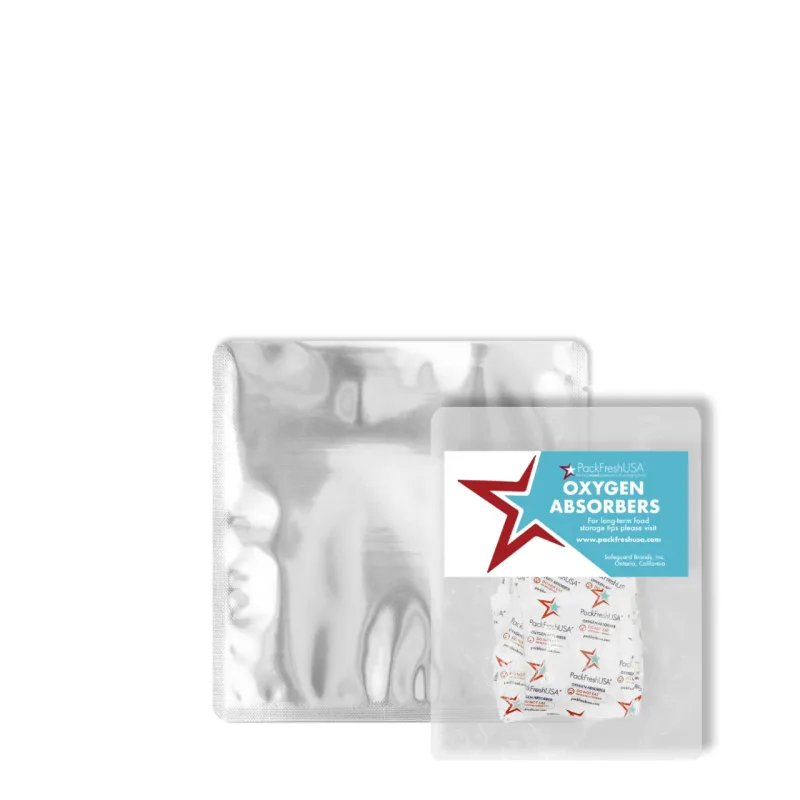
Sold by Sublime Pantry: Snack Bags 6×6 — 100 Pack with Absorbers. Sublime Pantry has no affiliate relationships, sponsorships, or paid placements as of publication. We sell packaging; where a product we sell appears, it is labeled.
Common questions
Why does freeze-dried candy puff up instead of shrinking?
Harvest Right's published mechanism is that the moisture inside the candy is removed through sublimation [1], and the gas already trapped in the piece expands into the space that water leaves. Fruit has no comparable trapped-gas structure, so it collapses instead. How much a piece expands is not settled: the same manufacturer publishes both “grow nearly double in size” [3] and “puff up and quadruple in size” [4] for gummy bears.
How long does a candy batch take?
The only manufacturer figure is a general one: candy batches are “often completing in just a few hours compared to the 13-35 hours required for most foods” [1]. Two secondary sources give conflicting hard-candy figures: 20-26 hours on a Medium unit, with nearly all of it final dry [6], versus 30-40 hours [7]. No cycle time is published anywhere for gummies, taffy, or Skittles-type candy. Sugar content is separately documented to lengthen cycles [10][12][13].
Can I freeze-dry chocolate?
Solid chocolate is advised against by manufacturer and secondary sources alike, because the process removes water but not fat: “Pure chocolate has a high fat content in the cocoa butter. It will leave an oily residue behind, and the texture will change” [9], and “Freeze drying removes water, but oil remains” [2]. Chocolate-coated candies are separately reported as working [4], a tension the manufacturer does not resolve.
Should I use an oxygen absorber or a desiccant with freeze-dried candy?
The documented failure mode for sugar is moisture, not oxidation. PackFreshUSA names sugar as particularly susceptible to moisture [15], Utah State University Extension states that removing oxygen for long-term sugar and honey storage “is not required and not recommended” [17], and a secondary source reports freeze-dried hard candy as intensely hygroscopic, going sticky and re-fusing if left open [6]. Whether to run both sorbents together is disputed among four manufacturers, with none of them publishing a test [14][15][20][22].
Which desiccant is food-safe?
SorbentSystems states that “only silica gel has been approved by the FDA for direct contact” with food and pharmaceutical items [18], and Multisorb notes amorphous silica gel is listed as GRAS [19]. Clay is described as ineffective for food applications, and molecular sieve as lacking FDA approval for food use in the U.S. [18]. Indicating silica gel, whether blue or orange, is not food-grade in either color [15][18]. Multisorb's own advice is to request a written food-contact statement citing the exact CFR sections or GRAS notices [19].
Can I sell freeze-dried candy from home?
That depends entirely on your state's cottage food law, and the published record is uneven. Texas states that freeze-dried foods are allowed as cottage foods if not otherwise excluded [24]; a Michigan extension answer paraphrases the state as permitting freeze-drying of non-potentially-hazardous foods “when using commercial equipment” [25]; Colorado lists candies among allowed cottage foods without addressing freeze-dried candy specifically [26]. Ask your own state agency in writing and keep the reply.
Sources
- Freeze Dried Candy — Why It Puffs Up and How to Make It at Home — Harvest Right primary · accessed 2026-09-06
- What Foods Can You Freeze Dry? A Complete Guide — Harvest Right primary · accessed 2026-09-06
- 5 Candies to Freeze Dry — Harvest Right primary · accessed 2026-09-06
- Freeze dry your extra Halloween candy into fun treats — Harvest Right primary · accessed 2026-09-06
- Freeze Dryer Customer Support — Harvest Right primary · accessed 2026-09-06
- Freeze Drying Jolly Ranchers and Hard Candy — freezedryfoundry.com secondary · accessed 2026-09-06
- Harvest Right Freeze Drying Time Chart — Trimleaf secondary · accessed 2026-09-06
- How to Freeze Dry Homemade Marshmallows — Roots & Boots secondary · accessed 2026-09-06
- What Foods Cannot Be Freeze Dried — Homesteading Family secondary · accessed 2026-09-06
- How to Freeze Dry Like a Pro: 25 Tips for Better Results — Harvest Right primary · accessed 2026-09-06
- Storing Freeze Dried Food — Harvest Right primary · accessed 2026-09-06
- Buying a Home Freeze-Dryer: What to Know Before You Go — Utah State University Extension primary · accessed 2026-09-06
- Freeze Drying For Home Use — UC ANR primary · accessed 2026-09-06
- Oxygen Absorbers Vs. Desiccants: Explaining the Difference — Multisorb primary · accessed 2026-09-06
- Desiccants: Moisture Absorbers — PackFreshUSA primary · accessed 2026-09-06
- How To Use Silica Gel Packets for Food Storage — Wallaby Goods primary · accessed 2026-09-06
- Storing Sugars — Utah State University Extension primary · accessed 2026-09-06
- Desiccant Types — SorbentSystems.com primary · accessed 2026-09-06
- Industry Compliant Desiccants: What You Need to Know — Multisorb primary · accessed 2026-09-06
- All About Desiccants USA — IMPAK Corporation primary · accessed 2026-09-06
- All About Oxygen Absorbers USA — IMPAK Corporation primary · accessed 2026-09-06
- Q & A — PackFreshUSA primary · accessed 2026-09-06
- Wallaby Goods FAQs — Mylar Bags & Long-Term Food Storage — Wallaby Goods primary · accessed 2026-09-06
- Texas Cottage Food Law FAQ (Q B-29) — Texas Cottage Food Law secondary · accessed 2026-09-06
- Cottage food eligible for freeze drying (Ask Extension Q&A, Michigan) — eXtension / Think Food Safety secondary · accessed 2026-09-06
- Candies and Confections (cottage food) — Colorado State University Extension primary · accessed 2026-09-06