The short version: for food dried in a home machine, the published answers split in two. Manufacturers publish up to 25 years or longer under ideal conditions [5][7]. The extension services that address home units recommend 5 to 10 years and state that the longer figure is unverified [1][3][4]; Utah State puts it in one line: “no real data exists on the shelf-life of home freeze-dried products” [2]. What you control is narrower than either number: Harvest Right names four causes of shortened shelf life, and they are incomplete drying, delayed sealing, the wrong oxygen absorber size, and poor storage conditions [5].
This page reports what published sources say and where they disagree. We publish all of the figures rather than picking one, and we make no shelf-life guarantee of our own. Nothing here establishes that a particular bag of food is safe to eat.
| Who says it | What they publish | What it is attached to |
|---|
| Harvest Right (manufacturer) | “Many properly packaged freeze-dried foods can last up to 25 years or longer under ideal conditions” [6] | A mylar bag with an oxygen absorber, stored cool, dark, dry and below 85 °F [6] |
|---|
| Blue Alpine (manufacturer) | The manufacturer claims 25+ years [7] | A high-quality mylar bag [7] |
|---|
| University of Minnesota Extension | Up to 25 years for commercially prepared product; limited information for home-prepared [8] | Commercial product, not home output [8] |
|---|
| Utah State Extension, January 2026 guide | 10 to 15 years, sometimes up to 25, for commercially produced food; it recommends against home-preserved freeze-dried food beyond 5 to 10 years [1] | Airtight, moisture-proof packaging [1] |
|---|
| Utah State Extension, buying guide | “No real data exists on the shelf-life of home freeze-dried products”; 8 to 10 years as a conservative estimate for commercially canned product [2] | Commercially produced food in metal-mylar-type pouches [2] |
|---|
| UC Agriculture and Natural Resources | The manufacturer claim “has not been corroborated by university studies for home freeze dryers”; consuming home freeze-dried product is not recommended beyond 5 to 10 years [3] | Home freeze dryers specifically [3] |
|---|
| Iowa State Extension | “There is no verification that food will last 25 years at this point” [4] | Home freeze drying [4] |
|---|
Why the two camps do not meet
Utah State gives its reason plainly: the first home freeze dryer went on sale in 2013 [2], which is fewer years ago than the longer figure claims. UC ANR and Iowa State reach the same conclusion for home units: the figure is unverified [3][4].
The manufacturer figures are also conditional in a way that is easy to drop when they are repeated. Harvest Right ties its number to a mylar bag with an oxygen absorber, kept cool, dark, dry and below 85 °F, and adds that “Foods that contain higher amounts of fat generally have shorter storage lives” [6]. Blue Alpine’s claim is attached to a high-quality mylar bag [7]. Neither is a statement about food in a jar on a kitchen shelf.
What shortens it: the four causes
Harvest Right names four causes of shortened shelf life: food not completely dry before packaging, delayed sealing after the cycle, incorrect oxygen absorber sizing, and inappropriate storage conditions [5]. Three of those four are decided in the few minutes after the door opens.
- Dryness comes first. Utah State’s oxygen absorber publication states that “Foods should be below 10% moisture content for storing with absorbers” [18]. A low-oxygen package does not make a damp food safe. NC State Extension states the consequence: “This low-oxygen environment is just right for the development of several pathogens, but one to be specifically concerned about is botulism” [19]. Utah State adds that “Freeze-drying does not kill bacteria. Instead, it preserves microorganisms in a dormant state” [16].
- Sealing delay. Harvest Right states that food not placed in an airtight container “will begin to reabsorb moisture from the air and spoil” [15].
- Absorber size. Sizing follows the air left in the sealed container. The guide to the cc number and the absorber calculator cover it.
- Storage conditions. Covered below; temperature is the only one with a published rate.
The package sets the ceiling
Penn State Extension attaches storage life to the packaging class rather than to the food: zip-top bags and plain containers give a few months; vacuum packaging in plastic gives 2 to 3 years because “plastic allows some permeability”; glass jars give many years, but only with an oxygen absorber or a vacuum seal; mylar requires both an absorber and a heat seal [9].
Utah State states the general case for plastics: they “are not that resistant to oxygen transfer and will allow significant oxygen levels into the container in 1 to 2 years”, and separately that “vacuum packaging is NOT a food preservation method by itself” [10]. Its specification for freeze-dried storage is 5 to 7 mil mylar with no clear plastic window, plus an oxygen absorber [1]. The reason a window disqualifies a bag is the foil: PackFreshUSA states that “It is only the aluminum on the surface that keeps the oxygen out” [17].
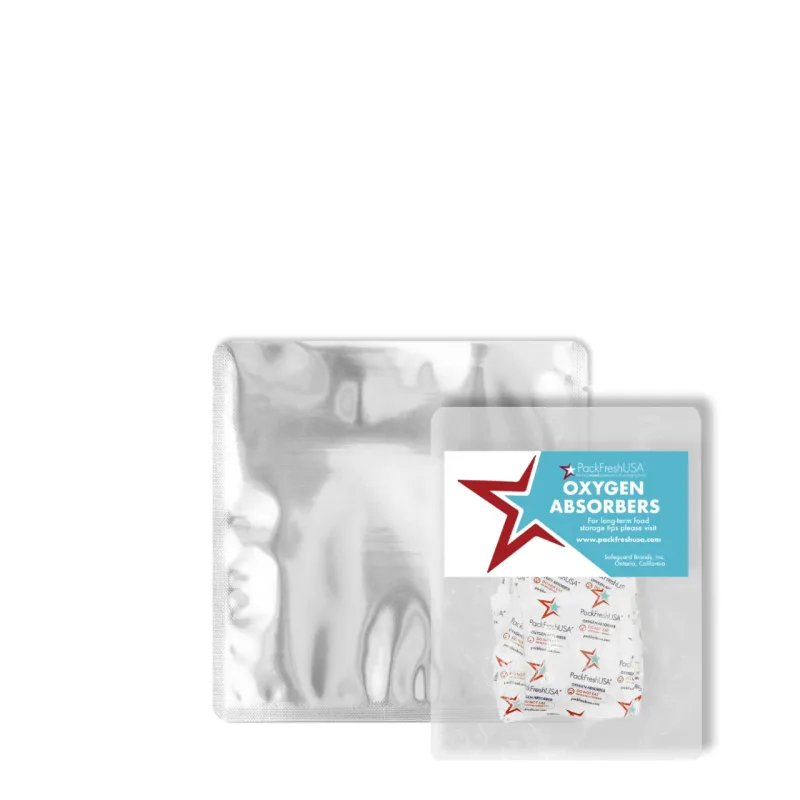
Our Starter Set is 50 foil mylar bags, 50 matched absorbers and the sealer that closes them. The bags are 4.3 mil, which is thinner than the 5 to 7 mil Utah State specifies [1], and we have not run a storage trial on them. Sold by Sublime Pantry.
Temperature is the one published rate
Utah State states that for every 10.8 degrees of temperature rise you halve the shelf life of stored food, with a storage range of 40 to 60 °F [11]. Clemson states that storage time decreases significantly above 75 °F [12], and Harvest Right conditions its own figure on storage below 85 °F [6]. BYU notes that attics and garages give a much shorter shelf life [14].
Fat is the other stated modifier. Harvest Right says higher-fat foods have shorter storage lives [6], and Utah State names rancidity as the risk that high fat content raises [1]. Light guidance is qualitative everywhere: minimal light, stored dark. No source in this set attaches a number to it [6].
Edible is not the same as pleasant
The figures in circulation are edibility figures, not taste figures. BYU says many dried foods “will have an acceptable taste for many years when stored at room temperature or below; however, some nutritional losses will occur”, and recommends rotating stored food on a seven-year cycle [14].
The one food where an extension service ran sensory panels shows what temperature does to taste. For nonfat dry milk, Utah State reports off-flavors at 6 months and an unacceptable product at 24 months at 90 °F; unacceptable at 4 years at 70 °F; and minimal flavor change at 52 months at 50 °F [13]. That is dried milk, not freeze-dried milk, and it is the only panel data in this set.
What no source publishes
- A long-run study of home freeze-dried food. Utah State, UC ANR and Iowa State all state that the longer figure is unverified for home units [2][3][4].
- A figure by food. The numbers are published as one envelope for everything, with fat as the only stated modifier [1][6]. No source publishes a storage life for candy at all.
- A number for light. Every source says dark or minimal light; none says how much or for how long [6].
- A valid range for the temperature rule. The 10.8-degree statement is published without one, and without the data behind it [11].
Next
Sold by Sublime Pantry: Starter Set — 50 Bags, 50 Absorbers, Sealer. Sublime Pantry has no affiliate relationships, sponsorships, or paid placements as of publication. We sell packaging; where a product we sell appears, it is labeled.
Common questions
Is the claim that home freeze-dried food lasts 25 years verified?
No. Harvest Right and Blue Alpine publish that figure as a manufacturer claim tied to mylar with an oxygen absorber and ideal storage [6][7]. UC ANR states it “has not been corroborated by university studies for home freeze dryers” and does not recommend consuming home freeze-dried product beyond 5 to 10 years [3], and Iowa State states “There is no verification that food will last 25 years at this point” [4].
How long does freeze-dried food keep in a mason jar or a vacuum bag?
Penn State Extension gives storage life by packaging class: a few months in zip-top bags or plain containers, 2 to 3 years vacuum packed in plastic because “plastic allows some permeability”, and many years in glass jars only with an oxygen absorber or a vacuum seal [9]. Utah State states that “vacuum packaging is NOT a food preservation method by itself” [10].
Does storage temperature change how long it keeps?
Yes, and it is the only factor with a published rate. Utah State states that every 10.8 degrees of temperature rise halves the shelf life of stored food and gives a storage range of 40 to 60 °F [11]. Clemson states storage time decreases significantly above 75 °F [12], and BYU notes attics and garages give a much shorter shelf life [14].