

The short version: for food you seal once and leave alone, the published barrier numbers point at foil-laminate mylar inside a rigid outer container: a 4.3 mil foil laminate is specified at 0.001 cc/m²/24 hrs oxygen transmission [1], while a 4.0 mil nylon/PE vacuum-sealer film from the same manufacturer is specified at 4.25 cc/100 in²/24 hrs [3]. For food you open every week, a jar earns its place on reseal, not on barrier. And no manufacturer in this set publishes a light-transmission figure for any finished food bag, so light is the one criterion here that cannot be ranked at all.
Packaging
Storage containers compared.
The five containers, compared
Every cell below is what a manufacturer, extension service or regulator publishes, reproduced in the units they published it in. Blank cells are absences, not omissions. The searches behind them are listed further down.
| Foil-laminate mylar bag | Mason / canning jar | Vacuum-sealer bag (nylon/PE or embossed) | Kraft pouch | Bucket / pail | |
|---|---|---|---|---|---|
| Barrier, as published | 4.3 mil PET/PE/foil/LLDPE: OTR 0.001 cc/m²/24 hrs, WVTR <0.0005 gr/100 in²/24 hrs [1]. 7.5 mil foil laminate: OTR <0.0005 cc/100 in²/24 hrs at 77°F, 90% RH [4]. The barrier is attributed to the metal, not the gauge: "It is only the aluminum on the surface that keeps the oxygen out" [12] | No OTR or WVTR figure published for glass in any source retrieved. Extension frames the jar as barrier-neutral and the closure as the variable: jars keep freeze-dried food "many years" only with an oxygen absorber or a vacuum seal [16] | 4.0 mil nylon/adhesive/PE: OTR 4.25 cc/100 in²/24 hrs, WVTR 0.26 gr/100 in²/24 hrs [3]. Extension is blunt about what vacuum does and does not do: "vacuum packaging is NOT a food preservation method by itself" [11]. Penn State puts vacuum-in-plastic at 2–3 years for freeze-dried food because "plastic allows some permeability" [16] | Two different products under one name. Foil-lined kraft (kraft/PE/foil/LDPE, 5.0 mil): OTR 0.01 cc/m²/24 hrs, WVTR 0.0005 gr/100 in²/24 hrs [2]. Window kraft: no foil; "This product does not have foil lining" [4], structure "Front: KPET/LLDPE, Back: Kraft/LLDPE" [4] or "Paper/PET/NY/LLDPE" [6], and neither publishes an OTR or WVTR at all [4][6] | No OTR or WVTR published for HDPE pails in any source retrieved. Extension states the general case for plastics: they "are not that resistant to oxygen transfer and will allow significant oxygen levels into the container in 1 to 2 years" [11], and prescribes the fix: "Lining PETE buckets with mylar will decrease this oxygen exchange" [18]. Working volume: a 5-gallon pail is 18,942 cc, a #10 can 3,980 cc [19] |
| Light | Opaque [1]. No % transmission published by any manufacturer searched. The only optical figure found anywhere is 3.0% haze for the bare PET layer [8] | Clear unless darkened. Extension recommends darkened jars for light-sensitive items such as dried milk [11] | Transparent, no light barrier [3] | Opaque on the kraft face; the window versions are the only deliberately transparent panel in this table [4][6] | Opaque or translucent depending on the pail. No figure published |
| Reseal | Yes, by cutting and re-sealing: "if opened carefully, polyester film bags can be resealed for multiple uses" [14], conditional on bag height remaining [15]. Each cycle consumes bag | The strongest of the five. The lid is the closure, and reseal is unlimited by design. Named by a manufacturer as the storage vessel for leftover absorbers: "an airtight glass jar or vacuum-sealed Mylar bag" [14] | Yes, if you own the sealer; each reseal shortens the bag | Heat-sealable [6]; stand-up format holds shape between openings | Lid-dependent; no published reseal-cycle data |
| Durability | Puncture >18 psi at 4.3 mil [1]. Rated as a liner, not a package: "Mylar is not strongly resistant to insect penetration and not resistant at all to rodents" [13] | Rigid and rodent-resistant, but breakable. No puncture or drop figure published | Puncture 20.5 lb [3]. Embossed consumer bags are 5-ply, 3 mil smooth / 8 mil mesh [7] | Not published by either manufacturer [4][6] | The rigid outer layer the mylar bag is explicitly said to need: mylar has "poor puncture resistance so it must be used as an interior liner for more puncture resistant containers" [13]. Not rodent-proof on its own: "If mice chew through your buckets, they'll go right through the bags" [13] |
| Cost, checked 2026-09-06 | 5-gallon 5.5 mil, 200-count case: $249.00 = $1.245/bag, falling to $199 per case at 6–10 cases [9] | Not published in any source in this set | Chamber-type 8.4375"×12.875", 500/case: $43.90 = $0.088/bag [3]. Embossed 6"×10", 100/carton: $16 = ~$0.16/bag, to $0.14 at 5+ cartons [7] | Foil-lined kraft stand-ups: $94.55–$206.35 per 1,000-count case by size [5]. Kraft window pouch, 1,000/carton: $272 = ~$0.27/pouch, $247 at 5+ cartons [6] | Not published in any source in this set |
| Where it fits | Sealed once, opened once, inside something rigid | Anything you open weekly | Freezer and short-cycle storage; a headspace-reduction step, not an oxygen step | Retail presentation and short shelf cycles | The outer shell around a lined bag |
Scrolls sideways.
Foil-laminate mylar bag
- Barrier, as published
- 4.3 mil PET/PE/foil/LLDPE: OTR 0.001 cc/m²/24 hrs, WVTR <0.0005 gr/100 in²/24 hrs [1]. 7.5 mil foil laminate: OTR <0.0005 cc/100 in²/24 hrs at 77°F, 90% RH [4]. The barrier is attributed to the metal, not the gauge: "It is only the aluminum on the surface that keeps the oxygen out" [12]
- Light
- Opaque [1]. No % transmission published by any manufacturer searched. The only optical figure found anywhere is 3.0% haze for the bare PET layer [8]
- Reseal
- Yes, by cutting and re-sealing: "if opened carefully, polyester film bags can be resealed for multiple uses" [14], conditional on bag height remaining [15]. Each cycle consumes bag
- Durability
- Puncture >18 psi at 4.3 mil [1]. Rated as a liner, not a package: "Mylar is not strongly resistant to insect penetration and not resistant at all to rodents" [13]
- Cost, checked 2026-09-06
- 5-gallon 5.5 mil, 200-count case: $249.00 = $1.245/bag, falling to $199 per case at 6–10 cases [9]
- Where it fits
- Sealed once, opened once, inside something rigid
Mason / canning jar
- Barrier, as published
- No OTR or WVTR figure published for glass in any source retrieved. Extension frames the jar as barrier-neutral and the closure as the variable: jars keep freeze-dried food "many years" only with an oxygen absorber or a vacuum seal [16]
- Light
- Clear unless darkened. Extension recommends darkened jars for light-sensitive items such as dried milk [11]
- Reseal
- The strongest of the five. The lid is the closure, and reseal is unlimited by design. Named by a manufacturer as the storage vessel for leftover absorbers: "an airtight glass jar or vacuum-sealed Mylar bag" [14]
- Durability
- Rigid and rodent-resistant, but breakable. No puncture or drop figure published
- Cost, checked 2026-09-06
- Not published in any source in this set
- Where it fits
- Anything you open weekly
Vacuum-sealer bag (nylon/PE or embossed)
- Barrier, as published
- 4.0 mil nylon/adhesive/PE: OTR 4.25 cc/100 in²/24 hrs, WVTR 0.26 gr/100 in²/24 hrs [3]. Extension is blunt about what vacuum does and does not do: "vacuum packaging is NOT a food preservation method by itself" [11]. Penn State puts vacuum-in-plastic at 2–3 years for freeze-dried food because "plastic allows some permeability" [16]
- Light
- Transparent, no light barrier [3]
- Reseal
- Yes, if you own the sealer; each reseal shortens the bag
- Durability
- Puncture 20.5 lb [3]. Embossed consumer bags are 5-ply, 3 mil smooth / 8 mil mesh [7]
- Cost, checked 2026-09-06
- Chamber-type 8.4375"×12.875", 500/case: $43.90 = $0.088/bag [3]. Embossed 6"×10", 100/carton: $16 = ~$0.16/bag, to $0.14 at 5+ cartons [7]
- Where it fits
- Freezer and short-cycle storage; a headspace-reduction step, not an oxygen step
Kraft pouch
- Barrier, as published
- Two different products under one name. Foil-lined kraft (kraft/PE/foil/LDPE, 5.0 mil): OTR 0.01 cc/m²/24 hrs, WVTR 0.0005 gr/100 in²/24 hrs [2]. Window kraft: no foil; "This product does not have foil lining" [4], structure "Front: KPET/LLDPE, Back: Kraft/LLDPE" [4] or "Paper/PET/NY/LLDPE" [6], and neither publishes an OTR or WVTR at all [4][6]
- Light
- Opaque on the kraft face; the window versions are the only deliberately transparent panel in this table [4][6]
- Reseal
- Heat-sealable [6]; stand-up format holds shape between openings
- Durability
- Not published by either manufacturer [4][6]
- Cost, checked 2026-09-06
- Foil-lined kraft stand-ups: $94.55–$206.35 per 1,000-count case by size [5]. Kraft window pouch, 1,000/carton: $272 = ~$0.27/pouch, $247 at 5+ cartons [6]
- Where it fits
- Retail presentation and short shelf cycles
Bucket / pail
- Barrier, as published
- No OTR or WVTR published for HDPE pails in any source retrieved. Extension states the general case for plastics: they "are not that resistant to oxygen transfer and will allow significant oxygen levels into the container in 1 to 2 years" [11], and prescribes the fix: "Lining PETE buckets with mylar will decrease this oxygen exchange" [18]. Working volume: a 5-gallon pail is 18,942 cc, a #10 can 3,980 cc [19]
- Light
- Opaque or translucent depending on the pail. No figure published
- Reseal
- Lid-dependent; no published reseal-cycle data
- Durability
- The rigid outer layer the mylar bag is explicitly said to need: mylar has "poor puncture resistance so it must be used as an interior liner for more puncture resistant containers" [13]. Not rodent-proof on its own: "If mice chew through your buckets, they'll go right through the bags" [13]
- Cost, checked 2026-09-06
- Not published in any source in this set
- Where it fits
- The outer shell around a lined bag
Five storage containers against the criteria published for each
The unit trap, before you compare any two rows. Three oxygen-transmission unit systems appear across these datasheets: cc/m²/24 hrs [1][2], cc/100 in²/24 hrs [3], and cc per 100 sq in/24 hrs at 100% oxygen [4]. One square metre is roughly 1,550 square inches. A reader who sets "0.001 cc/m²/24 hrs" [1] beside "4.25 cc/100 in²/24 hrs" [3] without converting will understate the gap by about three orders of magnitude. Test conditions make it worse: only the 7.5 mil sheet states its temperature and humidity (77°F at 90% RH) [4]; the 4.3 mil and vacuum-film sheets give the ASTM method and no conditions at all [1][3].
Thickness is measured two ways by two sellers. One manufacturer publishes "7.5 mil per side (15 mil total)" [10]; the datasheet grade of the same nominal thickness states 7.5 mil as the film gauge, i.e. per wall [4]. This matters at the seal more than at the barrier: a bag manufacturer points out that a 7-mil bag presents "7-mil on each side = 14 mil total sealing thickness" [20], and one 12" tabletop sealer rated to 8 mil for ordinary bags caps "Metalized Food Bags" at 2.5 mil on the same machine [21].
For food kept sealed
This is the case the foil laminate is built for, and the case where the container is the smaller half of the decision. The published mylar specification for freeze-dried food is narrow: "5–7 mil thickness, no clear plastic window," plus an oxygen absorber [17]. The window is disqualifying, which is exactly why the kraft-window pouches in the table above sit in a different section.
Two preconditions travel with every shelf-life figure attached to a sealed container. The food has to be dry ("Foods should be below 10% moisture content for storing with absorbers" [18]), and a low-oxygen package does not make a wet food safe. NC State Extension states the consequence plainly: "This low-oxygen environment is just right for the development of several pathogens, but one to be specifically concerned about is botulism," and adds that "these disease-causing bacteria may not change the color or look of the food" [22]. Vacuum sealing does not substitute for either condition [11][22]. Extension measurement of small-scale freeze-dryer output found "the water activity did not ever rise above 0.6, indicating that no food safety or spoilage risk occurred" [26], and USU puts finished freeze-dried product at "about 0.3 or below, with many products falling in the range of 0.08–0.33" [17].
Absorber sizing is where sources stop agreeing. For a one-gallon container, the published figures in this set run 300 cc from extension [18] and 700 cc from the freeze-dryer manufacturer, carrying only the condition "For use in gallon-size Mylar bags" [27]; it is the highest figure found and the thinnest condition attached to one. Extension's 2011 numbers are quart 50 cc, gallon or #10 can 300 cc, and three 500 cc packets for a 5-gallon container [18]. Sizing is by residual air volume, not food weight, and the reference volumes are 18,942 cc for a 5-gallon pail and 3,980 cc for a #10 can [19].
Expect no visual confirmation. Absorbers take the oxygen fraction only, so "1/5 of the air volume will be gone but 4/5 of the air will always remain" [15], and a vacuum-packed look is not a test: "It's a misconception that a 'vacuum-packed' look confirms the oxygen has been removed" [14]. The published checks are mechanical: once cool, "try to pull the mouth of the bag open. If it doesn't come open…" the seal is holding, and folding the bag into a pail until trapped air pillows up and watching whether it deflates [13]. Foil micro-cracks at the folds are normal ("Tiny breaks in the foil layer…are not holes… their barrier properties are not significantly affected" [12]), and a bag that passes light through a flashlight test is not thereby defective, since "inside a metalized bag in a cool, dark storage place, there is virtually no effect from light" [12]. Absorbers themselves have a short open window: use within 15 minutes, and a spent one is "brown and clumped together compared to a fresh pink or gray powder" [18].
Seal temperature, where anyone publishes it: 400°F / 40 PSI / 1 sec for the 4.3 mil foil laminate [1], 375–425°F for a flat iron on 7-mil bags [20], and 250–300°F published by one seller for the bare PET layer only, not the laminate [8]. A home user who takes the 250–300°F figure to a foil bag will under-seal it. And a vacuum sealer is not disqualified as a sealer: one manufacturer endorses using a FoodSaver with the pump off, "just use the sealing feature" [15], while a bag maker says the machine cannot manage 14 mil of stack [20]. Both positions are published; neither is tested.
For food opened often
Here the ranking inverts. A mylar bag is a single-seal package that gives up height every time you cut it [14][15], and an oxygen absorber is single-use: once its capacity is spent it does not recharge, which is why re-adding one is part of every reseal. A jar closes and reopens indefinitely, and extension puts glass with an absorber or a vacuum seal at "many years" while zip-top bags get "a few months" and vacuum-in-plastic 2–3 years [16].
The sorbent also changes. For repeatedly opened containers the documented failure mode is moisture, not oxidation: a packaging manufacturer names freeze-dried goods in re-opened containers, along with salt and sugar, as the desiccant cases, and gives the physical separation rule if you run both: "Oxygen absorbers have built in moisture to make them work; it is imperative to keep the desiccants separated from the oxygen absorbers" [28]. Published desiccant sizing is "about 1 gram of silica gel for roughly 120 cubic inches of space," which works out at 1–2 grams for a standard mason jar and 5–10 grams for a quart or gallon mylar bag [29]. Whether desiccants and absorbers belong in the same container at all is disputed between manufacturers, and none of them publishes a test.
One practical consequence of the jar: it is clear. Extension recommends darkened jars for light-sensitive items such as dried milk [11], and the freeze-drying guidance rules out clear windows in bags for the same reason [17], while a manufacturer argues light is irrelevant in a dark cupboard [12]. Nobody publishes a number that would settle it, which is covered below.
For carrying or selling
A pouch that travels is judged on presentation and closure as much as on barrier, and this is where the two kraft products separate. The foil-lined kraft laminate is a real barrier material with a published OTR of 0.01 cc/m²/24 hrs [2]; the window pouches that look like it are not, and their manufacturers say so: "This product does not have foil lining" [4], with structures that contain no metal layer [4][6]. Neither window pouch publishes an oxygen or moisture transmission figure [4][6]. If a customer stores your product for a year, that difference is the whole product.
The rules on selling are state law, and they are not uniform. Some examples of the shapes they take, as published:
- Ohio restricts the packaging method directly: "Cottage food products may not be packed using reduced oxygen packaging" [23]. That reaches an absorber-in-mylar pack.
- Illinois permits dehydrated foods and states a target rather than a filing: "Are dehydrated foods allowed? Yes, as long as no prohibited ingredients (such as meat, dairy, etc.) are included. For safety, aim for a water activity of 0.85 or less" [24]. Its pH language, by contrast, requires a lab report [24].
- New York lists "Freeze-dried foods" among products prohibited under its home processing exemption, and prohibits home drying of fruits and herbs while permitting repackaging of commercially dried ones [25].
Labeling elements recur across states: producer name and address, product name, ingredients by weight, allergens, net weight. But the required disclosure sentence is written per state and does not port across a state line [23][24][25]. Sublime Pantry describes what these documents say; it does not tell you what is permitted where you live. The operative step is to ask your own state agency in writing and keep the reply.
What we could not source
- A light-transmission figure for any finished food bag. Every source treats light qualitatively. The only numeric optical property found in the whole search is 3.0% haze for a bare PET layer [8]. No container in the table above can be ranked on light, and no extension source publishes a lux figure, an exposure duration, or a vitamin-loss percentage to rank them against.
- Oxygen or moisture transmission for glass jars and HDPE buckets. Neither appears in any retrieved datasheet. The bucket case rests on a general statement about plastics at 1–2 years [11] and on the instruction to line them [18].
- Barrier numbers from the largest consumer mylar seller. Site-restricted searches for an OTR or WVTR value returned product and FAQ pages carrying marketing language only: no numeric barrier figure, no layer identities beyond "three layers," no seal temperature. The specification data in this article comes from a converter that publishes datasheets [1][2][3][4].
- Retail per-bag pricing for the case-only items. The kraft and vacuum SKUs above are sold by the case, so there is no comparable small-quantity price [3][5][6].
- Whether "7.5 mil" means one wall or two. One seller publishes per side and total [10]; the datasheet grade publishes film gauge [4]. Unreconciled, and it decides whether a given sealer is in or out of spec [20][21].
- A freeze-dried class on any absorber sizing chart. The charts stop at "pasta and thicker, less dense foods." The one freeze-dryer manufacturer figure found, 700 cc per gallon bag [27], carries no food class and no fill level.
- Sublime Pantry has bench-tested none of this. Every figure above is somebody else's published claim, with its units, conditions and publisher attached.
Next
- Kraft versus mylar — the bag decision, in detail.
- Six beliefs the manufacturers contradict — the folklore around sealing and absorbers.
- When stored food fails — what each container's failure mode looks like.
Sold by Sublime Pantry: Snack Bags 6×6 — 50 Pack — the mylar half of this comparison, with the absorber already matched to the bag.
Tools mentioned in this guide
- Sold by Sublime Pantry
Snack Bags 6×6 — 50 Pack with Absorbers
50 six-by-six mylar bags at 4.3 mil, with 50 matched 100cc oxygen absorbers. Single-serving and small-batch portions.
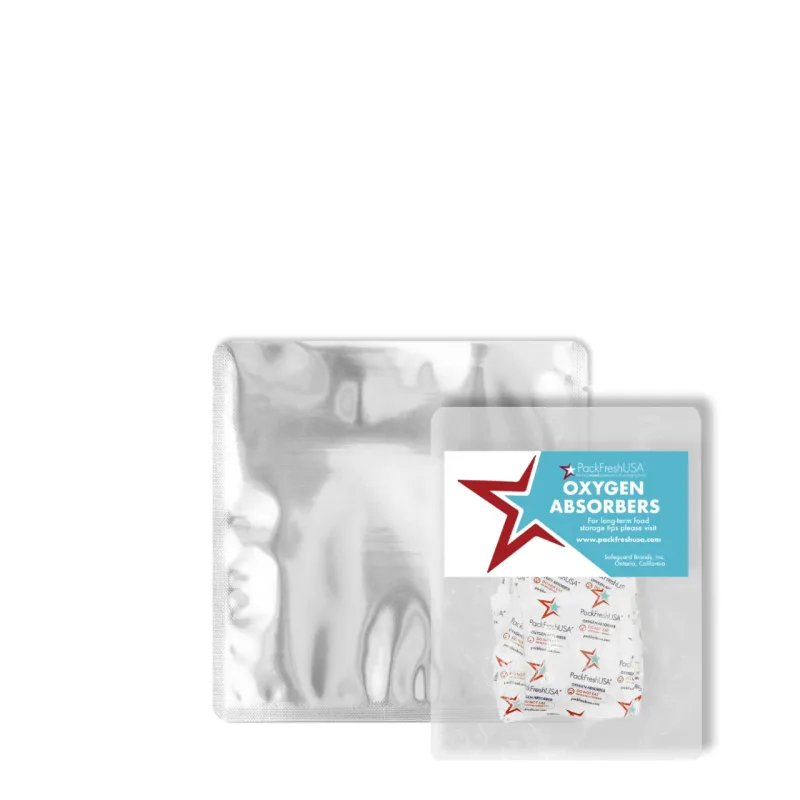
Sold by Sublime Pantry: Snack Bags 6×6 — 50 Pack with Absorbers. Sublime Pantry has no affiliate relationships, sponsorships, or paid placements as of publication. We sell packaging; where a product we sell appears, it is labeled.
Common questions
Is a mylar bag really that much better than a vacuum-sealer bag?
On published oxygen transmission the gap is large, but you have to convert before you can see it. A 4.3 mil foil laminate is specified at 0.001 cc/m²/24 hrs [1]; a 4.0 mil nylon/PE vacuum film from the same manufacturer is specified at 4.25 cc/100 in²/24 hrs [3]. One square metre is about 1,550 square inches, so the raw numbers understate the difference by roughly three orders of magnitude. Neither datasheet states test conditions [1][3], and extension separately notes that "vacuum packaging is NOT a food preservation method by itself" [11].
Do I need a bucket if the food is already in mylar?
The published position is that the bag is a liner, not a package: mylar has "poor puncture resistance so it must be used as an interior liner for more puncture resistant containers," and it is "not strongly resistant to insect penetration and not resistant at all to rodents" [13]. The same source is candid that the pail is not the answer either: "If mice chew through your buckets, they'll go right through the bags" [13]. Extension adds the barrier argument for pairing them: plastics "will allow significant oxygen levels into the container in 1 to 2 years" [11], and "Lining PETE buckets with mylar will decrease this oxygen exchange" [18].
Are kraft pouches with a window a barrier package?
The window versions are not, and the manufacturers say so in their own listings: "This product does not have foil lining" [4], with structures of KPET/LLDPE over kraft/LLDPE [4] or Paper/PET/NY/LLDPE [6] (no metal layer in either), and no OTR or WVTR published for either [4][6]. A foil-lined kraft laminate is a different material with a published OTR of 0.01 cc/m²/24 hrs [2]. The freeze-drying guidance is separately explicit that storage bags should have "no clear plastic window" [17].
My sealed bag never sucked down. Did the seal fail?
Not necessarily, and suck-down is not a test. An absorber takes the oxygen fraction only, so "1/5 of the air volume will be gone but 4/5 of the air will always remain" [15], and one manufacturer names the belief directly: "It's a misconception that a 'vacuum-packed' look confirms the oxygen has been removed" [14]. The published checks are mechanical: once cool, try to pull the mouth of the bag open, and fold the bag into a pail until trapped air pillows up and watch whether it deflates [13].
Which container should I use if I open the food every week?
A jar closes and reopens indefinitely, where a mylar bag loses height at every cut [14][15] and needs a fresh absorber each time. Penn State puts glass with an oxygen absorber or a vacuum seal at "many years" for freeze-dried food, against "a few months" for zip-top bags and 2–3 years for vacuum-in-plastic [16]. The sorbent changes too: for repeatedly opened containers the documented failure mode is moisture, with published sizing of about 1 gram of silica gel per 120 cubic inches, or 1–2 grams in a mason jar [29]. If you run both sorbents, one manufacturer requires physical separation and gives the reason: "Oxygen absorbers have built in moisture to make them work" [28].
Sources
- PAKVF4 Specification Sheet — Sorbent Systems (IMPAK Corporation) primary · accessed 2026-09-06
- PAKVF4K Specification Sheet — Sorbent Systems (IMPAK Corporation) primary · accessed 2026-09-06
- PAKVAC4.0 Specification Sheet — Sorbent Systems (IMPAK Corporation) primary · accessed 2026-09-06
- PAKDRY7500 Specification Sheet — Sorbent Systems (IMPAK Corporation) primary · accessed 2026-09-06
- Kraft Bags — Kraft Stand Up Pouches & Flat Bags — Sorbent Systems (IMPAK Corporation) primary · accessed 2026-09-06
- Paper Stand-Up Barrier Pouches with Window, Kraft, 6x9x3" (S-22248) — ULINE primary · accessed 2026-09-06
- Uline Vacuum Bags for FoodSaver 6x10" (S-20395) — ULINE primary · accessed 2026-09-06
- Information About our Mylar Layer — Discount Mylar Bags primary · accessed 2026-09-06
- 5 Gallon 5.5 Mil Heavy Duty Mylar Bags (200) — Wholesale — PackFreshUSA primary · accessed 2026-09-06
- Mylar MRE Pouches with Oxygen Absorbers — Wallaby Goods primary · accessed 2026-09-06
- Packaging Foods (Preserve the Harvest) — Utah State University Extension primary · accessed 2026-09-06
- Myths & Misconceptions: Oxygen Absorbers & Mylar Bags — PackFreshUSA primary · accessed 2026-09-06
- Mylar Bags — Food Storage FAQ — USA Emergency Supply secondary · accessed 2026-09-06
- Wallaby Goods FAQs — Mylar Bags & Long-Term Food Storage — Wallaby Goods primary · accessed 2026-09-06
- Q & A — PackFreshUSA primary · accessed 2026-09-06
- Let's Preserve: Freeze-Drying — Penn State Extension primary · accessed 2026-09-06
- Can I Freeze-Dry That? A Practical Guide to Safe and Effective Freeze-Drying — Utah State University Extension primary · accessed 2026-09-06
- Oxygen Absorbers (FN/Food Preservation/2011-01pr) — Utah State University Extension primary · accessed 2026-09-06
- StayFresh Oxygen Absorbers — Measuring Volume of Space — Sorbent Systems (IMPAK Corporation) primary · accessed 2026-09-06
- Heat Sealing 7-Mil Mylar Bags — Top Mylar primary · accessed 2026-09-06
- Tabletop Impulse Sealer – 12" (H-190) — ULINE primary · accessed 2026-09-06
- Vacuum Packing — NC State Extension primary · accessed 2026-09-06
- Ohio Administrative Code 901:3-20-04, Cottage food products allowed — Ohio Legislative Service Commission primary · accessed 2026-09-06
- Cottage Food Guide (2022) — Illinois Department of Public Health primary · accessed 2026-09-06
- Home Processing (Home Processor exemption) — New York State Department of Agriculture and Markets primary · accessed 2026-09-06
- FST-506NP — Factors that Impact Small-Scale Freeze Dryer Effectiveness — Virginia Cooperative Extension / Virginia Tech primary · accessed 2026-09-06
- 50-Pack Oxygen Absorbers — Harvest Right primary · accessed 2026-09-06
- Desiccants: Moisture Absorbers — PackFreshUSA primary · accessed 2026-09-06
- How To Use Silica Gel Packets for Food Storage — Wallaby Goods primary · accessed 2026-09-06