

The short version: Kraft with a window is packaging for food you will eat this season; foil mylar is packaging for food you are putting away. Every kraft window pouch with a published structure that we found (IMPAK, ULINE, PackFreshUSA) omits foil [3][4][6][7], and IMPAK says so directly of its own window pouch: "This product does not have foil lining" [4]. The only kraft material in this set with a published oxygen transmission rate is foil-lined, and it has no window [2].
Packaging and storage
Kraft vs mylar: what you're paying for
The criteria, stated before any scoring
Six criteria, fixed before we looked at a single number, so the comparison is not built backwards from a conclusion:
- Barrier (OTR / WVTR). Oxygen and water-vapour transmission rate as the manufacturer publishes it, with the test method attached. A number with no unit is not a spec.
- Light. Opaque, windowed, or fully transparent, plus whether anyone publishes a measured light-transmission figure.
- Thickness and puncture. Mil as published, per side or total, plus puncture or burst with the test method.
- Cost per bag. Published price divided by count, dated, with the size attached.
- Seal behaviour. Published seal temperature, pressure and dwell, and whether the seller publishes any at all.
- What it is not suited for. The failure the material invites, taken from what the source itself states.
The unit trap comes first, because it breaks most comparisons in this category. Three different oxygen units appear across these datasheets: cc/m²/24 hrs, cc/100 in²/24 hrs, and cc per 100 sq in/24 hrs at 100% oxygen [1][11][13][12]. One square metre is roughly 1,550 square inches. A reader who sets "0.001 cc/m²/24 hr" beside "4.25 cc/100 in²/24 hr" without converting understates the gap by about 1,550×. Every figure below carries its unit in the cell; none of them have been normalised.
The table
| Material | Layer construction | Thickness | OTR (as published) | WVTR (as published) | Light | Puncture / burst | Seal temp | Price as listed |
|---|---|---|---|---|---|---|---|---|
| Kraft with clear window (IMPAK AVK2HHZ) | Front: KPET/LLDPE, Back: Kraft/LLDPE [3] | 4.7 mil [3] | not published [3][4] | not published [3][4] | Clear front panel; explicitly no foil lining [4] | not published [3] | not published [3] | $166.00 / 1,000-ct case = $0.1660/bag; $0.1051/bag at 25+ cases [3] |
| Kraft with window (ULINE S-22248) | Paper/PET/NY/LLDPE [6] | 6–7 mil [6] | not published [6] | not published [6] | Window 3 3/8 × 2 5/16 in [6] | not published [6] | Heat-sealable; temperature not published [6] | $272 / 1,000 = ~$0.27/pouch; $247 at 5+ cartons [6] |
| Kraft with window (PackFreshUSA SUP) | Kraft paper / PET barrier / food-grade PE lining [7] | 5.5 mil [7] | "<=0.5" — no unit, no method published [7]; not usable as a spec | "<=0.5" — same [7] | Rectangular high-clarity window [7] | Seal strength >=40.0 N/15mm; no puncture figure [7] | Impulse-sealer compatible; no temperature published [7] | Medium 5.5×8.75×2.5 in, 100 ct: $34.99 [7] |
| Foil-lined kraft, no window (PAKVF4K) | Kraft Paper/PE/Foil/LDPE; foil min. 0.00035 in [2] | 5.0 mil [2] | 0.01 cc/m²/24 hrs (ASTM D-3985) [2] | 0.0005 gr/100 in²/24 hrs (ASTM F-1249) [2] | Opaque; no window [2] | Puncture not published; tensile 29 psi MD / 20 psi XMD [2] | not published [2] | Flat kraft bags $0.099–$0.309/unit by tier [4]; SUP cases $94.55–$206.35 / 1,000 [5] |
| Metallized PET (PAKVF2.5M / 3.5M / 5M) | 48 g MET PET / LLDPE [8][9] | 2.5 / 3.5 / 5.0 mil [8][9][10] | 0.02 cc/m²/24 hrs [8][9][10] | 0.05 gr/100 in²/24 hrs (ASTM F-1249) [8][9][10] | Opaque metallized [8] | Puncture >13 psi at 2.5 mil, >16 psi at 3.5 and 5.0 mil; burst >50 / >70 psi [8][9][10] | not published [8][9][10] | not published [8][10] |
| Foil mylar, 4.3 mil (PAKVF4) | 48GaPET / PE / .00035 FOIL / LLDPE [1] | 4.3 mil [1] | 0.001 cc/m²/24 hrs (MOCON) [1] | <0.0005 gr/100 in²/24 hrs (ASTM F-1249) [1] | Opaque foil [1] | Puncture >18 psi (FTMS 101-C); Mullen burst 69 psi [1] | 400°F / 40 PSI / 1 sec [1] | case/converter item; retail not published [1] |
| Foil mylar, 5.6 mil (PAKVF56T) | 48 GaPET / adh / .00035 FOIL / LLDPE [11] | 5.6 mil [11] | 0.001 cc/m²/24 hrs certified max; 0.0006 measured [11] | <0.005 gr/100 in²/24 hrs certified max; 0.0003 measured [11] | Opaque foil [11] | Puncture 19.1 lbs (FTMS 101); Mullen burst 57 lb/in² [11] | 400°F / 40 PSI / 1 sec [11] | case/converter item [11] |
| Foil mylar, 7.5 mil (PAKDRY7500) | 48ga PET / .00035 Foil / 60ga BON / LLDPE 6.1 mil metallocene PE [12] | 7.5 mil minimum [12] | <0.0005 cc, 100% O2, per 100 sq in/24 hrs, 77°F @ 90% RH (ASTM D-3985) [12] | <0.0006 gms, 100°F, per 100 sq in/24 hrs (ASTM F-1249) [12] | Opaque foil [12] | Puncture >38 lbs; burst >130 psi [12] | 425°F / 40 PSI / 1 sec [12] | case/converter item [12] |
| Nylon/PE vacuum-sealer film (PAKVAC4.0) | 60ga Nylon / Adhesive / PE [13] | 4.0 mil [13] | 4.25 cc/100 in²/24 hrs (ASTM D-3985) [13] | 0.26 gr/100 in²/24 hrs (ASTM F-1249-90) [13] | Transparent — no light barrier [13] | Puncture 20.5 lb (FTMS 101-C) [13] | not published [13] | $43.90 / 500 = $0.0878/bag; $0.0748 at 10+ cases [13] |
Prices checked 2026-09-06. Sizes differ row to row; these are per-bag figures for the size listed, not a like-for-like comparison.
Barrier: where the actual gap is
On a single unit basis, the foil-lined kraft laminate publishes 0.01 cc/m²/24 hrs and the 4.3 mil foil mylar publishes 0.001 cc/m²/24 hrs [2][1]. That is a tenfold difference between two foil materials from the same manufacturer, and it is the comparison people expect this article to be about. It is not the important one.
The important one is that none of the three kraft window pouches publishes an oxygen transmission rate at all [3][6][7]. IMPAK's window versions drop the foil by construction [5], and the company states it plainly on the product page: "This product does not have foil lining" [4]. ULINE sells its Paper/PET/NY/LLDPE window pouch under the heading "Barrier Pouch" and publishes no OTR or WVTR figure for it [6]. PackFreshUSA publishes "<=0.5" for both moisture and oxygen on its kraft window pouch with no unit and no test method attached [7]; a bare number with no unit cannot be compared to anything, so we have not used it.
Utah State University Extension states the mechanism and the timescale without hedging: "Plastics are not that resistant to oxygen transfer and will allow significant oxygen levels into the container in 1 to 2 years," and "The foil layer dramatically reduces the transmission of oxygen and moisture through the film." [14]
Discount Mylar Bags publishes an OTR of .4 g/m²/day for what it calls Mylar, then scopes it itself: "These values are for only the Mylar layer," and separately, the aluminium foil layer "provides the bulk of protection in a Mylar bag" [15]. Two numbers on the same page describe different things, which is worth knowing before you cite either.
The vacuum-bag comparison, converted. The nylon/PE vacuum film publishes 4.25 cc/100 in²/24 hrs [13]. Converted at 15.5 hundred-square-inch units per square metre, that is roughly 66 cc/m²/24 hrs, against 0.001 cc/m²/24 hrs for the 4.3 mil foil laminate [1]. Test conditions are not published for either datasheet: both give the ASTM method and no temperature or relative humidity. Treat that as an order-of-magnitude difference, not a certified ratio.
Light is the criterion nobody quantifies. No manufacturer in this set publishes a percentage light-transmission figure for a finished food bag. Every source handles it qualitatively. The only numeric optical property found anywhere was 3.0% haze, and that was for the bare PET layer, not a bag [15]. A window is a gap in the light barrier by construction; how large a gap is not a published number, and we are not going to invent one.
Durability: thickness is not a comparable spec
"7.5 mil" is measured three different ways by three sellers of a nominally identical bag. Wallaby publishes "7.5 mil per side (15 mil total)" [17]; Discount Mylar Bags publishes "7.5 mil per side" [16]; PackFreshUSA publishes "7.5 mil" with no per-side qualifier on its MRE page [18], while its own 5 mil and 7 mil gallon pages do say per side [20][19]. The IMPAK datasheet treats 7.5 mil as the minimum film gauge, meaning per wall [12]. A buyer comparing two "7.5 mil" bags may be comparing a single-wall figure to a doubled one.
Puncture is no better. PAKVF4 reports ">18 psi" and PAKDRY7500 reports ">38 lbs," both citing FTMS 101 [1][12]. Those are not the same measurement. A cross-brand puncture ranking cannot be derived from published data, so this article does not contain one. The kraft window pouches publish no puncture figure at all [3][6][7].
One thing worth flagging on the marketing side: PackFreshUSA's line "burst strength of over 140 psi, equivalent to the weight of 5 cinder blocks per square inch" appears verbatim on its 4.3 mil, 5 mil and 7 mil pages alike [21][20][19]. The same figure attached to three different thicknesses reads as site-wide copy rather than a per-material measurement.
Seal behaviour
Seal conditions are published for very few of these materials. PAKVF4: 400°F / 40 PSI / 1 sec [1]. PAKVF56T: the same [11]. PAKDRY7500: 425°F / 40 PSI / 1 sec [12]. Discount Mylar Bags publishes "Heat Sealing: Optimal at 250–300°F (121–149°C) with 1–2 seconds dwell time" [15]. That page, however, scopes its figures to the bare Mylar layer, not the finished laminate [15]. Those two ranges are 100–175°F apart and are not describing the same thing.
On the kraft side, the foil-lined kraft laminate publishes heat-seal strength but no temperature [2]; ULINE says its window pouch is heat-sealable and gives no temperature [6]; PackFreshUSA says impulse-sealer compatible and gives no temperature [7]. If you are sealing kraft, no manufacturer in this set has told you at what setting.
One mechanical point that applies to both: a seal closes two bag walls, not one, so a 7 mil bag presents 14 mil of stack to the machine.
Cost per bag
Kraft is cheaper per bag, and the gap is real, but the two categories are priced through different channels. Kraft pouches are sold case-pack; consumer mylar is sold in retail bundles. All figures below were checked 2026-09-06 and are per bag at the size listed.
| Item | Size | Price as listed | Per bag |
|---|---|---|---|
| IMPAK kraft window pouch (AVK2HHZ) | 3.75 × 8.0 × 2.25 in | $166.00 / 1,000-ct case [3] | $0.1660; $0.1051 at 25+ cases [3] |
| ULINE kraft window barrier pouch (S-22248) | 6 × 9 × 3 in | $272 / carton of 1,000 [6] | ~$0.27; ~$0.247 at 5+ cartons [6] |
| IMPAK foil-lined kraft stand-up pouches | various, 3.125×5×2 in to 7.625×11.75×4 in | $94.55–$206.35 per 1,000-ct case [5] | $0.09–$0.21 [5] |
| PackFreshUSA kraft window SUP, medium | 5.5 × 8.75 × 2.5 in | $34.99 / 100 ct [7] | ~$0.35 — see the caveat below [7] |
| PackFreshUSA 4.3 mil foil mylar, 5-gallon | 19 × 28 in | $20.99 per 5- or 10-count pack [21] | $2.10–$4.20 depending on pack [21] |
| PackFreshUSA 5 mil foil mylar, gallon | 10 × 14 in | $36.99 per 50 or 100 ct [20] | $0.37–$0.74 depending on pack [20] |
| PackFreshUSA 7 mil foil mylar, gallon | 10 × 14 in | $39.99 per 50 or 100 ct [19] | $0.40–$0.80 depending on pack [19] |
| PackFreshUSA 5.5 mil foil mylar, 5-gallon (wholesale) | 20 × 30 in | $249.00 / case of 200 [22] | $1.245; down to $199/case at 6–10 cases [22] |
| Wallaby 7.5 mil "MRE" pouches | 6.5 × 8.5 in | $14.39 / 10 ct (sale from $15.99) [17] | ~$1.44 [17] |
| Discount Mylar Bags 7.5 mil, pint | 5 × 8 × 3 in | $17.99–$33.99 for 50–100 ct [16] | $0.34–$0.36 [16] |
| Nylon/PE vacuum-sealer pouch (QXV4R) | 8.4375 × 12.875 in | $43.90 / 500 [13] | $0.0878; $0.0748 at 10+ cases [13] |
| ULINE FoodSaver-compatible vacuum bags | 6 × 10 in | $16 / carton of 100 [23] | $0.14–$0.16 [23] |
One price caveat we could not resolve. The PackFreshUSA kraft window page lists medium 100 ct and medium 500 ct at the same $34.99, and large 100 ct and 500 ct also both at $34.99, while separately stating a per-bag range of $0.35 to $0.07 [7]. Those cannot all be correct. Re-check that page before relying on any per-bag figure from it.
The honest read: at case quantities, kraft runs roughly $0.09–$0.27 a bag and consumer foil mylar runs roughly $0.34–$1.44 a bag [3][5][6][16][20][17][22]. Some of that spread is material and some of it is channel. The bag sizes are also not equivalent: a 20 × 30 in five-gallon mylar bag and a 3.75 × 8 in kraft pouch are not the same purchase.
When kraft is right (honestly)
Kraft with a window earns its place when the thing you need is visibility and shelf presence at low unit cost, and the food is going to move. Retail display, a farmers-market table, cottage sales where the buyer wants to see the product, a sampler pack, granola or a snack mix leaving your kitchen this month. At $0.10–$0.17 a bag in case quantities [3], it is the cheapest presentable format in this comparison, and the window is the entire reason it exists.
What you are giving up is quantified nowhere, which is itself the point: for a foil-free kraft window pouch, no manufacturer we found publishes an OTR, a WVTR, a puncture figure, or a seal temperature [3][6][7]. "Barrier pouch" as ULINE labels its S-22248 [6] is a category name, not a measurement. If you buy on that label expecting long storage, you are buying a claim with no number under it.
There is a middle option people miss. Foil-lined kraft exists and does publish numbers: PAKVF4K, 5.0 mil, Kraft Paper/PE/Foil/LDPE, 0.01 cc/m²/24 hrs and 0.0005 gr/100 in²/24 hrs [2]. IMPAK describes it as "Kraft paper laminated with a foil layer, giving it high oxygen and water vapor barrier properties" [5]. You get the kraft look and a published barrier figure. You do not get the window: adding one removes the foil [5][4]. That is the trade, stated as the manufacturer states it.
When mylar is right
Foil mylar earns its place when the food is going away and staying away. The distinguishing feature is not that it is thicker (thickness is barely comparable across sellers, as above); it is that the barrier, the puncture resistance and the seal conditions are all published, with methods attached: 0.001 cc/m²/24 hrs by MOCON, <0.0005 gr/100 in²/24 hrs by ASTM F-1249, puncture by FTMS 101-C, seal at 400°F / 40 PSI / 1 sec [1]. You can check the claim. On a foil-free kraft window pouch there is nothing to check.
It is also opaque, which matters for the same reason the window is attractive: light gets in through clear film. Nobody publishes how much [15], but the foil bag does not have the opening at all.
One spec worth knowing if you are buying by grade rather than by brand: IMPAK publishes foil gauge, and states that the industry-standard competitor gauge is .000285 in against its own .00035 in and .0005 in constructions [24]. Its film index lists roughly four dozen named materials with individual datasheets [25]. No other manufacturer in this comparison publishes foil gauge at all.
What we could not source
- Any barrier number from PackFreshUSA. No OTR, WVTR, puncture force or seal temperature appears anywhere on their product pages or their site search results. Every PackFreshUSA figure in this article is marketing-sourced and labelled as such [7][18][19][20][21][22].
- A percentage light-transmission figure for any finished food bag, from any manufacturer. Light barrier is handled qualitatively everywhere. The only numeric optical property found in the entire research set was 3.0% haze for a bare PET layer [15]. A light-blocking ranking is not derivable from published data.
- Puncture resistance for any kraft window pouch [3][6][7].
- Seal temperature for the foil-lined kraft laminate and for the nylon/PE vacuum film. Both datasheets give heat-seal strength in lb/in width and no temperature [2][13].
- Test conditions for most of the film datasheets. Only PAKDRY7500 states its conditions (77°F @ 90% RH for OTR, 100°F for MVTR) [12]. PAKVF4, PAKVF56T, PAKVF5M, PAKVF2.5M, PAKVF3.5M, PAKVF4K and PAKVAC4.0 give the ASTM method and no temperature or humidity [1][11][10][8][9][2][13]. Those figures are method-only, not clean comparables.
- Retail single-bag pricing for the IMPAK and ULINE items. They are case-pack only; there is no comparable 50-count retail bundle to set against the consumer mylar prices [3][5][6].
- First-party specifications for FoodSaver-brand bags. The published claim is "BPA-Free Multilayer Construction" with no mil, no layer identities, no OTR, no WVTR and no seal temperature. ULINE's compatible equivalent at least publishes 5-ply construction at 3 mil smooth / 8 mil embossed [23].
Next
- What bag thickness actually means — the mil rating, and what it does not measure.
- Storage containers compared — the same decision widened past bags.
- What the cc number on an absorber means — sizing the absorber to whichever bag you pick.
Sold by Sublime Pantry: Snack Bags 6×6 — 100 Pack — the mylar side of this comparison, with absorbers matched to the bag.
Tools mentioned in this guide
- Sold by Sublime Pantry
Snack Bags 6×6 — 100 Pack with Absorbers
100 six-by-six mylar bags at 4.3 mil, with 100 matched 100cc oxygen absorbers. Single-serving and small-batch portions.
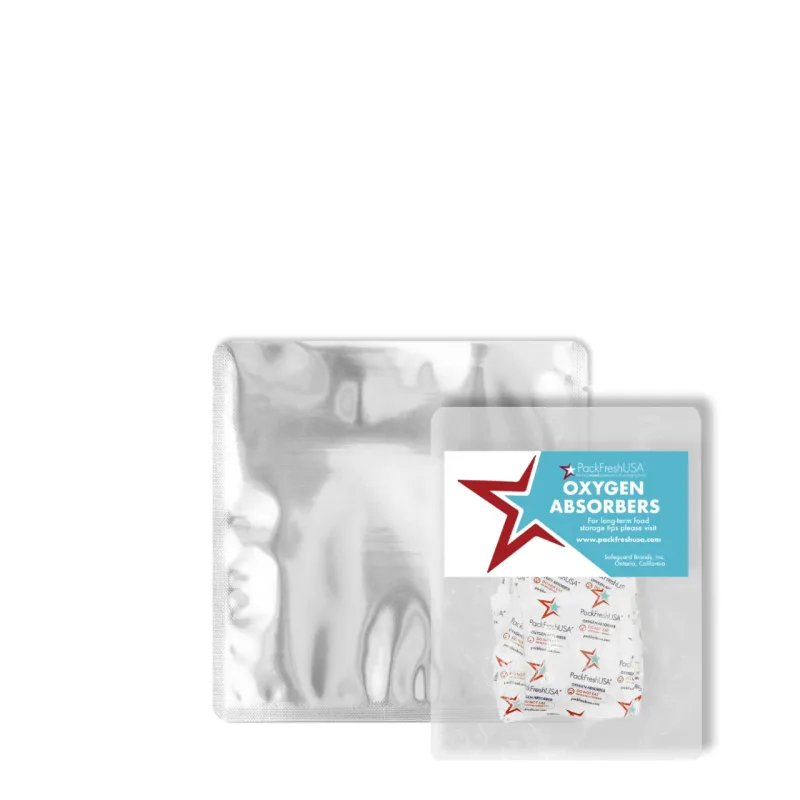
Sold by Sublime Pantry: Snack Bags 6×6 — 100 Pack with Absorbers. Sublime Pantry has no affiliate relationships, sponsorships, or paid placements as of publication. We sell packaging; where a product we sell appears, it is labeled.
Common questions
Does a kraft bag with a window work for long-term storage?
No manufacturer we found publishes a barrier figure for a foil-free kraft window pouch, so there is nothing to evaluate it against. IMPAK states its window pouch "does not have foil lining," and its window versions drop the foil by construction. Utah State University Extension notes that plastics "will allow significant oxygen levels into the container in 1 to 2 years." If you want kraft with a published barrier number, foil-lined kraft (0.01 cc/m2/24 hrs) exists, but it has no window.
Is thicker mylar always a better barrier?
The published data does not support that as a rule. Metallized PET publishes 0.02 cc/m2/24 hrs at 2.5, 3.5 and 5.0 mil alike, while foil laminate publishes 0.001 cc/m2/24 hrs at 4.3 mil. Structure, specifically whether there is a foil layer, moves the number more than thickness does. Thickness tracks puncture and burst more closely than it tracks barrier.
What does "7.5 mil" actually mean?
It depends on the seller. Wallaby publishes "7.5 mil per side (15 mil total)." Discount Mylar Bags publishes "7.5 mil per side." PackFreshUSA publishes "7.5 mil" with no qualifier on its MRE page while using "per side" on its gallon pages. The IMPAK datasheet treats 7.5 mil as the minimum film gauge, meaning per wall. Two bags advertised at the same mil may differ by a factor of two.
Can I use vacuum-sealer bags instead of mylar?
They are a different barrier class. The published nylon/PE vacuum film runs 4.25 cc/100 in2/24 hrs, which converts to roughly 66 cc/m2/24 hrs, against 0.001 cc/m2/24 hrs for 4.3 mil foil laminate. Test conditions are not published for either, so treat it as an order-of-magnitude difference rather than a precise ratio. Utah State University Extension also states that "vacuum packaging is NOT a food preservation method by itself."
What temperature should I seal at?
For the materials that publish it: PAKVF4 and PAKVF56T at 400 degrees F / 40 PSI / 1 second, and PAKDRY7500 at 425 degrees F / 40 PSI / 1 second. Discount Mylar Bags publishes 250 to 300 degrees F with 1 to 2 seconds dwell, but scopes that page's figures to the bare Mylar layer rather than the finished laminate. No manufacturer in this set publishes a seal temperature for kraft laminates. Note that a seal closes two bag walls, so a 7 mil bag presents 14 mil of stack to the machine.
Sources
- PAKVF4 Specification Sheet — Sorbent Systems (IMPAK Corp.) primary · accessed 2026-09-06
- PAKVF4K Specification Sheet — Sorbent Systems (IMPAK Corp.) primary · accessed 2026-09-06
- AVK2HHZ — 3.75"x8.0"x2.25" Clear/Kraft Hang Hole Stand Up Vista Pouch — IMPAK Corporation primary · accessed 2026-09-06
- Kraft Bags — Kraft Stand Up Pouches & Flat Bags — Sorbent Systems (IMPAK Corp.) primary · accessed 2026-09-06
- Kraft Pouches (stand-up kraft bags) — IMPAK Corporation primary · accessed 2026-09-06
- Paper Stand-Up Barrier Pouches with Window, Kraft, 6x9x3" (S-22248) — ULINE primary · accessed 2026-09-06
- 5.5 mil Kraft with Window Stand Up Pouches — PackFreshUSA primary · accessed 2026-09-06
- PAKVF2.5M Specification Sheet — Sorbent Systems (IMPAK Corp.) primary · accessed 2026-09-06
- PAKVF3.5M Specification Sheet — Sorbent Systems (IMPAK Corp.) primary · accessed 2026-09-06
- PAKVF5M Specification Sheet — Sorbent Systems (IMPAK Corp.) primary · accessed 2026-09-06
- PAKVF56T Specification Sheet — Sorbent Systems (IMPAK Corp.) primary · accessed 2026-09-06
- PAKDRY7500 Specification Sheet — Sorbent Systems (IMPAK Corp.) primary · accessed 2026-09-06
- PAKVAC4.0 Specification Sheet / QXV4R Transparent Vacuum Seal Pouch — Sorbent Systems (IMPAK Corp.) primary · accessed 2026-09-06
- Packaging Foods (Preserve the Harvest) — Utah State University Extension secondary · accessed 2026-09-06
- Information About our Mylar Layer — Discount Mylar Bags primary · accessed 2026-09-06
- Mylar Bags — 7.5 Mil Heavy Duty — Discount Mylar Bags primary · accessed 2026-09-06
- Mylar MRE Pouches with Oxygen Absorbers — Wallaby Goods primary · accessed 2026-09-06
- 7.5 Mil MRE Mylar Full-Portion Bags and Oxygen Absorbers — PackFreshUSA primary · accessed 2026-09-06
- Gallon 7 Mil Premium Mylar Food Storage Bags — PackFreshUSA primary · accessed 2026-09-06
- Gallon 5 Mil Heavy Duty Mylar Food Storage Bags — PackFreshUSA primary · accessed 2026-09-06
- 5-Gallon Standard Mylar Food Storage Bags — PackFreshUSA primary · accessed 2026-09-06
- 5 Gallon 5.5 Mil Heavy Duty Mylar Bags (200) — Wholesale — PackFreshUSA primary · accessed 2026-09-06
- Uline Vacuum Bags for FoodSaver 6x10" (S-20395) — ULINE primary · accessed 2026-09-06
- Mylar Base Barrier Bags and Pouches — Sorbent Systems (IMPAK Corp.) primary · accessed 2026-09-06
- Technology / Material Specification index — Sorbent Systems (IMPAK Corp.) primary · accessed 2026-09-06